
Can You Put a Septic System on Your Property? Understanding Perc Tests & Septic Site Evaluations in San Diego County
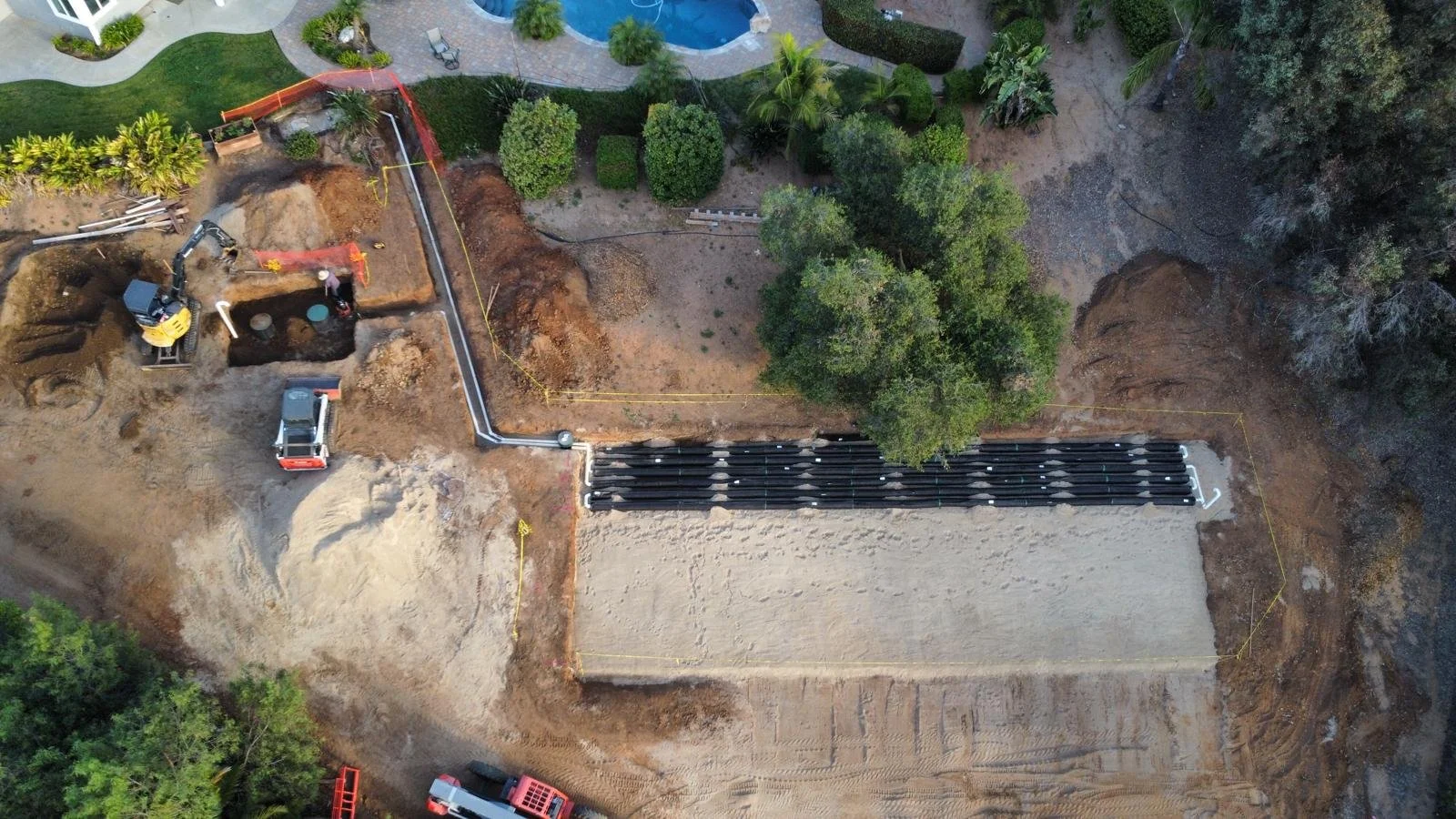
Finding a beautiful piece of land in Fallbrook, Bonsall, Oceanside, Valley Center, Temecula, Ramona or another unsewered part of San Diego County doesn't necessarily mean you can build exactly what you have in mind.
One of the biggest questions may be underground:
Can the property support a septic system?
Before an Onsite Wastewater Treatment System (OWTS) can be designed for new development, the site needs to be evaluated to determine whether wastewater can be safely treated and dispersed there.
One of the most familiar parts of that process is the percolation test—or “perc test.”
But a perc test is only part of the story.
Soil conditions, groundwater, slope, setbacks, available disposal area and the size of the proposed development can all affect what type of septic system can be approved.
What Is a Septic Perc Test?
A percolation test evaluates how quickly water moves through the soil in the proposed wastewater dispersal area.
That matters because after wastewater receives primary treatment in the septic tank, the effluent ultimately needs an approved place to disperse into the soil.
If water moves through the soil too slowly—or site conditions otherwise aren't suitable—the property may require a different OWTS design or may face development limitations.
In San Diego County, percolation testing for site evaluations must be conducted under DEHQ permit and inspection using County procedures. The testing must be performed by an appropriately registered Qualified Professional.
So this isn't something a property owner should try to test with a shovel and garden hose.
What Does a Perc Test Tell You?
The test produces a percolation rate, generally expressed in minutes per inch (MPI).
That result becomes one of the factors used to design and size the wastewater dispersal system.
For residential properties, San Diego County explains that disposal-field sizing is based on a combination of percolation-test results and the number of bedrooms in each dwelling unit. Septic-tank sizing is also based on bedroom count.
That's an important point if you're evaluating undeveloped land.
The question isn't simply:
“Does this property pass a perc test?”
A more useful question is:
“What type and size of development can this property support with an approved OWTS?”
Is There Such a Thing as “Passing” or “Failing” a Perc Test?
People often talk about land “passing perc,” but the actual process is more nuanced.
San Diego County uses percolation results as part of the overall site evaluation and OWTS design.
Under the County's current LAMP, soils with percolation rates greater than 120 minutes per inch are considered impermeable and unsuitable for an OWTS dispersal area.
But even a usable percolation rate doesn't automatically mean the property can accommodate whatever development you want.
The rest of the site still matters.
How Many Perc Test Holes Are Required?
This is another reason a legitimate septic evaluation is more involved than simply digging one hole.
Under San Diego County's current requirements, sites with an average percolation rate of 60 MPI or less generally require at least six test holes within the proposed primary and reserve areas.
When the average rate exceeds 60 MPI, the County requires additional testing, including a minimum of eight test holes. Different dispersal designs can have additional testing requirements.
The purpose is to make sure the results reasonably represent the soil conditions throughout the area proposed for wastewater dispersal.
Groundwater Matters Too
Good soil isn't the only requirement.
The County's site-evaluation process also considers groundwater separation.
This is important because wastewater needs sufficient separation from groundwater to allow appropriate treatment and protect water quality and public health.
San Diego County's current LAMP specifically identifies groundwater evaluation as part of determining whether a site is suitable for OWTS use.
Depending on the property, groundwater monitoring or additional evaluation may be necessary.
What About Slope?
Slope can also affect septic feasibility and design.
San Diego County currently requires sites with slopes exceeding 25% to include a slope-stability report or statement from a licensed civil engineer or geologist with the OWTS layout.
That's particularly relevant in parts of North County where a parcel may be large but much of the usable land is hillside.
A four-acre property doesn't necessarily have four acres available for septic.
Once you account for the home, driveway, grading, slopes, wells, property lines and other required setbacks, the usable OWTS area can become much smaller.
What Is the Septic Reserve Area?
One of the biggest surprises for property owners is that you don't necessarily need land for only one disposal field.
An OWTS design also needs to account for a reserve area that can accommodate replacement dispersal if the original field eventually fails.
The reserve area therefore needs to be protected from development that would prevent its future use.
This matters when you're planning things like:
ADUs
Pools
Garages
Barns
Workshops
Additions
Driveways
Retaining walls
Future development
A piece of apparently unused land may actually be an important part of the property's wastewater plan.
Can I Put a Pool or ADU Where the Septic Reserve Area Is?
This is exactly the kind of question that should be resolved before designing the improvement.
The County considers the area needed for an OWTS and its reserve area part of the property's development constraints.
Building over or otherwise compromising required OWTS areas can create problems when seeking approval for additional development.
If you're considering an ADU in particular, this ties directly into the issue we discussed in our earlier guide to ADU septic requirements in San Diego County.
→ Read: Adding an ADU to a Property With Septic in San Diego County
Who Performs Septic Site Evaluations in San Diego County?
This is an important distinction between design and installation.
San Diego County requires site evaluations and OWTS design services to be completed by a DEHQ-approved Qualified Professional. The County maintains a current list identifying which professionals are approved for services including soil profiles, percolation testing, groundwater monitoring and various OWTS designs.
Once the site has been evaluated and the OWTS designed and approved, the septic installer constructs the system according to those approved plans.
Red Rock Industrial performs the installation side of that process.
What If a Conventional Septic System Won't Work?
That doesn't necessarily mean the property can't be developed.
Depending on the specific site constraints and approved design, a property may be able to use a Supplemental Treatment System (STS) or another approved OWTS configuration.
San Diego County currently approves both conventional and supplemental treatment systems. Supplemental systems require percolation testing and design by a licensed OWTS Professional.
Red Rock Industrial installs conventional systems as well as specialized and advanced OWTS technologies, including Presby and SludgeHammer® systems.
→ Read: Conventional vs. Alternative Septic Systems in San Diego County
This is another reason it's better to evaluate the property properly rather than assuming that a difficult conventional septic site automatically means the project is impossible.
Buying Land? Investigate Septic Before You Commit
If you're considering purchasing undeveloped property that isn't served by sewer, septic feasibility should be part of your due diligence.
Before assuming a parcel can support the home, ADU or other development you're envisioning, consider determining:
Whether the parcel is sewered or requires an OWTS
Whether historical septic records exist
Whether previous percolation testing has been performed
What development those prior evaluations contemplated
Whether additional testing is required
Whether sufficient primary and reserve dispersal areas exist
Whether slope or groundwater creates additional requirements
Whether the proposed bedroom count can be accommodated
San Diego County maintains historical septic records through its Environmental Health Document Library, which can be useful when investigating an existing property.
Previous test data can sometimes remain useful as well: the County's current LAMP says older percolation-test data performed using approved methods dating back to 1978 may be valid for later OWTS design, subject to County requirements.
Ready to Install Your San Diego County Septic System?
Once your Qualified Professional has completed the evaluation and you have an approved OWTS design, Red Rock Industrial can take the project into construction.
Red Rock Industrial is a San Diego County-approved septic installer and California Class A General Engineering Contractor, with more than 20 years of underground piping experience.
We install:
Conventional septic systems
Supplemental and alternative treatment systems
Presby systems
SludgeHammer® systems
Septic infrastructure for ADUs and new construction
If you already have approved septic plans, send them over and we can review the installation scope.
→ Learn more about Red Rock Industrial's Septic System & OWTS Installation services.